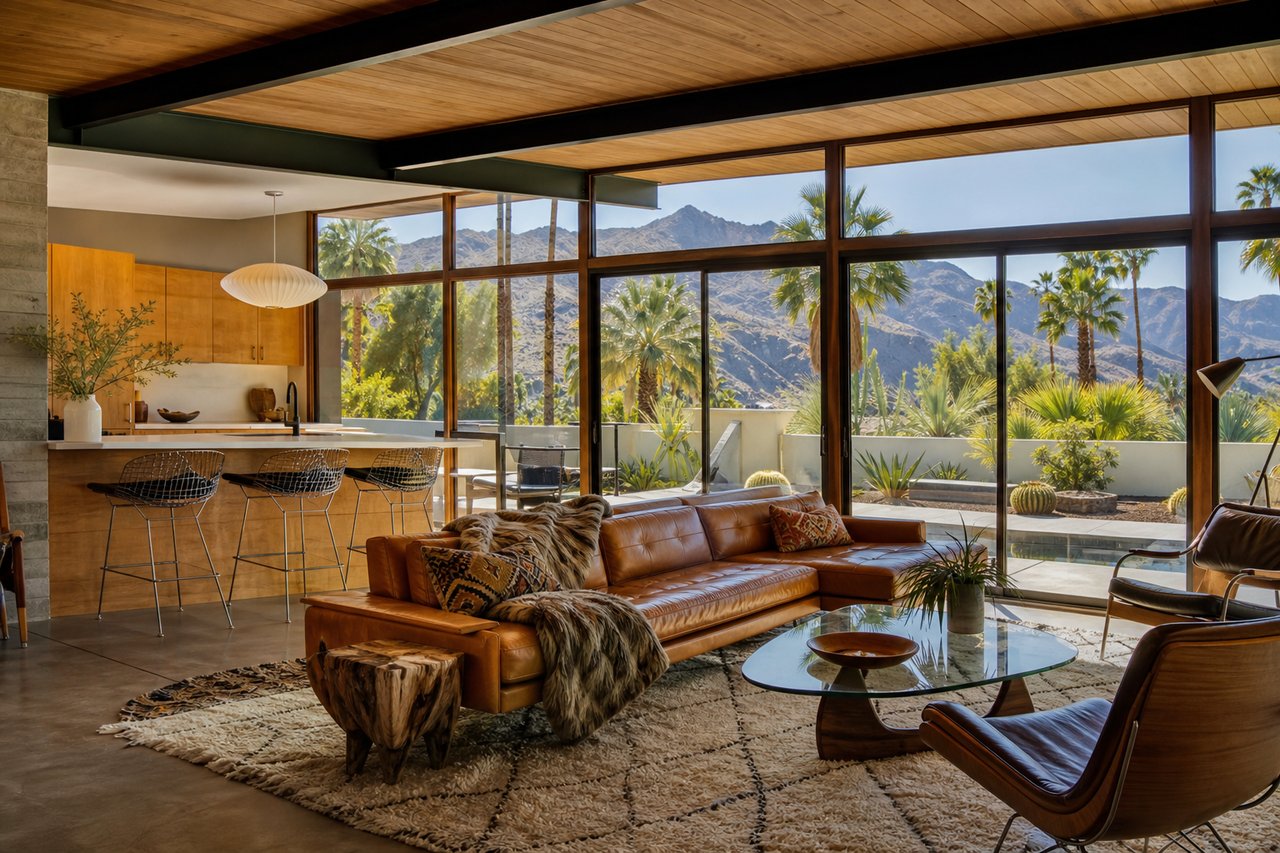
Why does Palm Springs keep attracting second-home buyers?
Palm Springs draws second-home buyers because it combines roughly 350 days of sunshine, a concentrated mid-century-modern architectural legacy, mountain-backed desert scenery, and a location about 107 miles east of Los Angeles. The city's population swells every November through May as part-time residents arrive, a pattern so consistent that the City of Palm Springs documents it in its own budget materials, and it shows no sign of fading in 2026.
Key Takeaways
- Palm Springs sits approximately 107 miles east of Los Angeles, putting it within easy driving range for Southern California second-home buyers.
- The City of Palm Springs reports roughly 350 days of sunshine annually, a core reason buyers choose the desert over coastal alternatives.
- The city's documented seasonal population increase runs from November through May, making those months the peak period for part-time residents.
- Palm Springs' citywide occupied-housing estimate is approximately 65.74%, reflecting a substantial share of homes used seasonally or intermittently rather than as full-time residences.
- The greater Palm Springs area drew an estimated 14.4 million visitors in 2023, generating roughly $9.0 billion in economic impact, figures that underscore its enduring destination status.
What makes Palm Springs different from other desert second-home markets?
A lot of desert cities offer warmth and low humidity. Palm Springs offers something harder to replicate: a civic identity built around a specific architectural era.
Mid-century-modern design is not just a real estate marketing label here. It is woven into the city's planning, preservation efforts, and cultural calendar. Buyers who want a home that feels like a genuine piece of design history, flat rooflines, post-and-beam construction, walls of glass opening onto mountain views, find a concentration of that inventory in Palm Springs that simply does not exist at the same scale elsewhere in the Coachella Valley.
That architectural identity also supports the city's appeal as a destination. According to the City of Palm Springs City Profile, the area attracts visitors and part-time residents drawn specifically to its design heritage alongside its natural setting. When a second home has genuine character, it tends to hold its appeal over time, both for the owner and for anyone they might host or rent to.
The desert setting itself is a draw that I hear buyers describe in ways that are hard to quantify. The quiet is different from coastal quiet. The scale of the landscape, open sky, the San Jacinto Mountains rising sharply to the west, gives the place a sense of remove that is genuinely difficult to find 107 miles from one of the largest cities in the country. For buyers who want a second home that actually feels like a retreat, that matters.
The seasonal rhythm that defines Palm Springs ownership
Palm Springs is not a year-round city in the way that Dana Point or Laguna Beach is. It is a city with a season, and understanding that rhythm is essential before you buy.
The City of Palm Springs FY 2026–27 Budget Book documents that the city's year-round population of approximately 45,000 increases substantially from November through May as part-time residents and visitors arrive. That is the season most second-home owners plan around: cooler temperatures, full cultural programming, and the social energy that comes with a city operating at its peak.
Summer in Palm Springs is hot. Many part-time owners simply close up the house and leave. That is not a flaw in the ownership model, it is the model. A buyer who understands this going in will plan their purchase, their carrying costs, and any rental strategy around it. A buyer who does not understand it sometimes ends up surprised.
The city's estimated occupied-housing rate of approximately 65.74%, reported in the same budget document, reflects this pattern at a citywide level. A meaningful share of Palm Springs homes are used seasonally or intermittently rather than as primary residences. That is not a sign of a weak market, it is the defining characteristic of a second-home market that has been functioning this way for generations.
The visitor economy as a signal of enduring demand
One way to gauge whether a second-home market has real staying power is to look at whether people keep choosing to visit, even when they do not own there. By that measure, Palm Springs is doing well. The most recent comprehensive figures, from calendar year 2023, show the greater Palm Springs area attracted an estimated 14.4 million visitors and generated approximately $9.0 billion in economic impact, according to the City of Palm Springs FY 2026–27 Budget Book.
Those are not current-year figures, and I want to be clear about that. But they establish something important: Palm Springs is not a niche destination that a small group of enthusiasts sustains. It is a major regional draw, and that visitor base underpins both the local economy and the rental demand that some second-home owners rely on.
How does buying a Palm Springs second home compare with buying on the Orange County coast?
This is a question I get from clients who are weighing both options, and the honest answer is that they serve different purposes.
A coastal second home in a market like Dana Point or Laguna Beach puts you at the water. Recent local market data show a median sale price of $2,005,000 in Dana Point and $3,362,500 in Laguna Beach, with homes typically spending 48 to 51 days on market. These are established luxury markets with deep demand and limited inventory. If proximity to the ocean is the priority, or if you want a second home that could eventually become a primary residence in a coastal setting, the Orange County coast makes a compelling case.
Palm Springs offers a different proposition: a lower price point in many segments, a distinct architectural identity, and a climate that appeals to buyers who want warmth and sun rather than ocean access. The two markets are not really competitors, they attract buyers with different lifestyle priorities. Some of my clients own in both.
Here is a quick look at where the Orange County coastal markets sit right now, for context:
Area | Median Sale Price | Median Days on Market |
|---|---|---|
Dana Point | $2,005,000 | 51 |
Laguna Beach | $3,362,500 | 48 |
Laguna Hills | $1,315,000 | 49 |
San Juan Capistrano | $1,299,500 | 39 |
San Clemente | $1,760,000 | 50 |
Source: Recent local market data, trailing approximately 90 days as of September 2026. Area-level medians, individual home values vary by condition, street, and timing.
For buyers who are specifically weighing the Palm Springs second-home market against a coastal purchase, I have a deeper look at that comparison in my post on whether Palm Springs is still a good second-home market for Dana Point investors in 2026.
What I tell every client who asks me this question directly: the right answer depends on how you plan to use the home, what your financial picture looks like, and whether you want a property that might eventually become your primary residence. Those are conversations worth having before you make an offer anywhere.
Short-term rental considerations
Some buyers look at Palm Springs with short-term rental income in mind, particularly given the city's documented visitor volume. That is a legitimate consideration, but it requires careful homework. Palm Springs regulates short-term rentals, and those regulations can affect when, how often, and under what conditions you can rent your home. Before factoring rental income into your purchase decision, verify the current rules directly with the City of Palm Springs and confirm how they apply to the specific property and neighborhood you are considering. I also recommend speaking with a tax advisor about how rental income from a second home is treated, since the rules differ depending on how many days per year you use the home personally versus renting it.
The National Association of Realtors' vacation-home county research offers useful context on how second-home markets behave nationally, though local rules always govern what is actually permitted in a specific city.
Your specific situation, how you plan to use the property, how often you will be there, and what your financing looks like, determines whether a Palm Springs purchase makes sense for you. That is exactly the kind of analysis I walk my clients through before we start looking at properties.
If you are also thinking about what a second home could mean for your longer-term financial picture, it is worth reading about luxury downsizing in Dana Point, some buyers find that a well-timed second-home purchase sets up a future primary-residence move that works in their favor.
The Orange County REALTORS® market data resource is a reliable starting point if you want current county-level housing figures to benchmark your thinking. The Consumer Financial Protection Bureau's mortgage resources are also worth reviewing if you are financing a second home, since the lending requirements for a second home differ from those for a primary residence.
I have been helping buyers and sellers navigate Southern California's luxury markets for over 26 years. If you are weighing a Palm Springs purchase alongside a coastal property, or simply want to understand what the numbers look like for your situation, reach out and let's talk through it.
You can also read what past clients have said about working with me on Zillow.
FAQ
Is Palm Springs still popular with second-home buyers in 2026?
Yes. Palm Springs' core appeal, roughly 350 days of sunshine, mid-century-modern architecture, mountain scenery, and proximity to Los Angeles, remains intact in 2026. The city's documented seasonal population surge from November through May reflects a second-home ownership pattern that has been consistent for decades, and the visitor economy that supports it continues to draw millions of people to the area each year.
Why do people buy second homes in Palm Springs instead of other desert cities?
Mid-century-modern architecture is the most commonly cited differentiator. Palm Springs has a concentration of architect-designed homes from that era that does not exist at the same scale elsewhere in the Coachella Valley. Combined with the city's cultural programming, established hospitality infrastructure, and name recognition, it offers a second-home experience that other desert markets do not fully replicate.
How seasonal is Palm Springs from November through May?
Very. The City of Palm Springs' own budget materials document that the city's population of approximately 45,000 year-round residents increases substantially from November through May as part-time residents and visitors arrive. Summer temperatures are high enough that many part-time owners close up their homes and leave, that seasonal rhythm is a feature of the ownership model, not a drawback, but buyers should understand it before purchasing.
Can a Palm Springs second home be used as a short-term rental?
Potentially, but Palm Springs regulates short-term rentals, and the rules affect when and how you can rent your home. Before factoring rental income into any purchase decision, verify the current regulations directly with the City of Palm Springs and consult a tax advisor about how rental income from a second home is classified for your specific situation.
How does Palm Springs compare with Dana Point for a second-home lifestyle?
They serve different priorities. Dana Point offers ocean access, a coastal climate, and a luxury market with a median sale price around $2,005,000 based on recent local market data. Palm Springs offers desert quiet, mountain scenery, abundant sunshine, and a distinct architectural identity. Some buyers own in both markets; the right choice depends on how you plan to use the home and what lifestyle you are buying into.
This article is general information only and does not constitute legal, tax, or financial advice. Confirm your specific numbers and circumstances with your closing agent, tax advisor, or lender. Equal Housing Opportunity. Coldwell Banker Residential | CA DRE# 00616212. Affiliated real estate agents are independent contractor sales associates, not employees. Regulated by the California Department of Real Estate (DRE).